
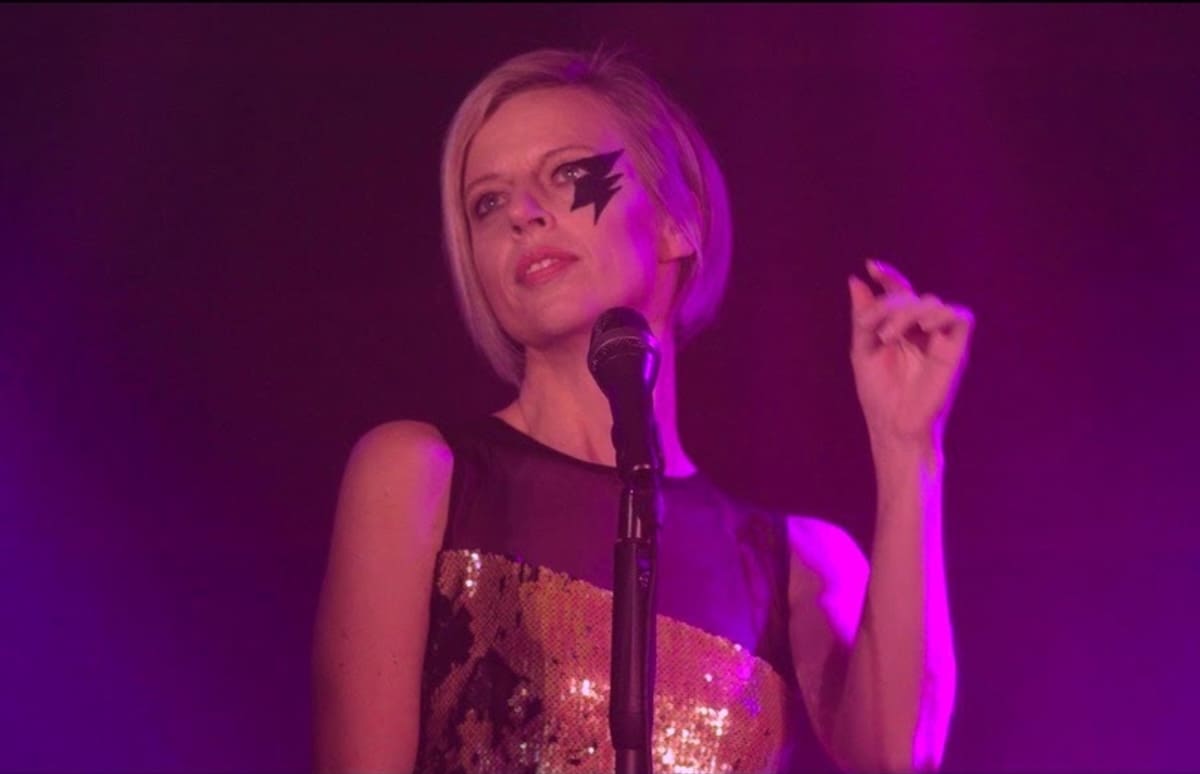
Before Kat Koan started writing songs, she recorded herself walking. Leaves, ice, pebbles, sand: the sounds beneath her feet became material to take home, rearrange and turn into rhythms. There was no album planned, no carefully plotted career change. There was simply something about sound that she wanted to understand.
“I never really studied music,” she says. “I just got really obsessed with how music can change a visual impact.”
Now based in Berlin, Kat has carried that curiosity into electronic music, spoken word and increasingly cinematic work. Her story involves very different albums, an unexpected connection with David Lynch collaborator Dean Hurley, and a growing interest in composing for film and television. But it is also a story about finding room for a creative life without having to turn it into a race for recognition.
Listening Before Writing
Her route into music began on the other side of the screen. After studying media arts and management, she worked at Bloomberg before moving into film and children’s television. It was there that she became fascinated by what happened when the image stayed the same but the soundtrack changed.
“I was always playing around with putting different sounds under the same scene, and just seeing how completely different it feels when you have a different kind of music under it, or a different soundscape.”
The recordings she made on her phone grew out of those experiments. At first, they were something she did entirely for herself. She collected sounds, assembled them and listened to what they became. Writing lyrics came later, following a period of burnout and a visit to a hypnotherapist.
“I literally walked out of that hypnotherapy session and I started writing lyrics,” she says. “I’d never done that before.”
What had begun as an interest in the emotional effect of sound was becoming a way to express emotions of her own.
A New City, a Different Version of Herself
Moving from London to Berlin gave that change somewhere to happen. In London, she remembers a more money-oriented atmosphere, with the constant pressure to promote yourself and get noticed. Berlin offered something she had not realised she needed: the freedom of being unknown.
“Sometimes when you move to a new place, you can have a new identity almost, because nobody has any expectations.”
Her first album, Lust Principle, emerged from that period. Its electronic sound bears Berlin’s influence, while its themes reflect her reading of philosophy and Freud as she tried to make sense of a changing life. She describes becoming interested in the relationship between pleasure and pain, and in allowing herself to experience both rather than looking for a permanently perfect existence.
“You need to go through some shitty times in order to really appreciate the cool moments, the good moments.”
An Unexpected Connection
Even then, an album was not the original ambition. She was making sounds and placing spoken-word passages over them when a producer in London heard a clip of a live performance and got in touch.
“He said, ‘Hey, do you want to make an album?’ And I was like, ‘Are you crazy?’”
They began working together without much expectation, travelling, recording and developing the material. The connection with Dean Hurley came through that producer, who played him some early demos while working on a commercial. Hurley offered to mix the tracks. Kat is careful to distinguish his role from production: the music had already been produced when he received it. What mattered most was the encouragement his interest gave her. For someone whose fascination with music had started with moving images, it was a particularly meaningful possibility.
Keeping Cocoon Close
Her second album, Cocoon, began with another unexpected invitation. During the pandemic, a collaborator in Belgium suggested making a record remotely. Working from separate countries, they created something that could hold the anger and sadness of that period while still feeling sheltered.
The title reflected the experience: a small, protected space in which something could take shape. Its release followed the same instinct. Available on vinyl and through Bandcamp, the album was something she wanted to put into the hands of people who genuinely cared about it.
Selling a record to someone at a gig, she explains, brings a satisfaction that a streaming figure does not. She is frustrated by a culture in which listener counts can become shorthand for an artist’s worth, even influencing opportunities to perform. But she would rather find a way of working she enjoys than let that frustration determine whether she makes music at all.
“I don’t want to make music to become famous,” she says. “I want to make music because I really, really love the process of making music and expressing emotions that I would never express in a conversation.”
Making Music on Her Own Terms
Some of Kat's most personal songs began with conversations with her daughters. “Tall” from the album The Tides Will Turn was written for her teenage daughter, who was struggling to recognise her own abilities, while “How Much Longer,” sung with her younger daughter and co-written with Nina Hynes, explores the urge to get out into the world and follow your dreams. Produced by Ainsley Adams, both songs have already found their way into television shows. Performing this material at Reeperbahn Festival was, Kat says, “a dream come true.”
Across her albums, she has little interest in settling into a recognisable sound. Each project begins with a feeling, an image or a theme that draws her into a different world.
“I just want to create a world that reflects that time in my life, something that feels authentic.”
She knows this makes her harder to place in a particular niche, but that does not trouble her. Her work as a hypnotherapist, which she loves, means music does not have to pay the bills.
“Not having to earn money from it, and not having an urge to ‘make it’ as an artist is so freeing. It allows me to do exactly what I want, whenever I want.”
That freedom extends to the process itself: no AI, plenty of trial and error, and collaborations with people whose company she enjoys as much as their talent. What keeps her making music is the chance to express feelings she might never put into conversation - and the pleasure of discovering what happens when people create something together.
Featured photo by Patrick Tichy