
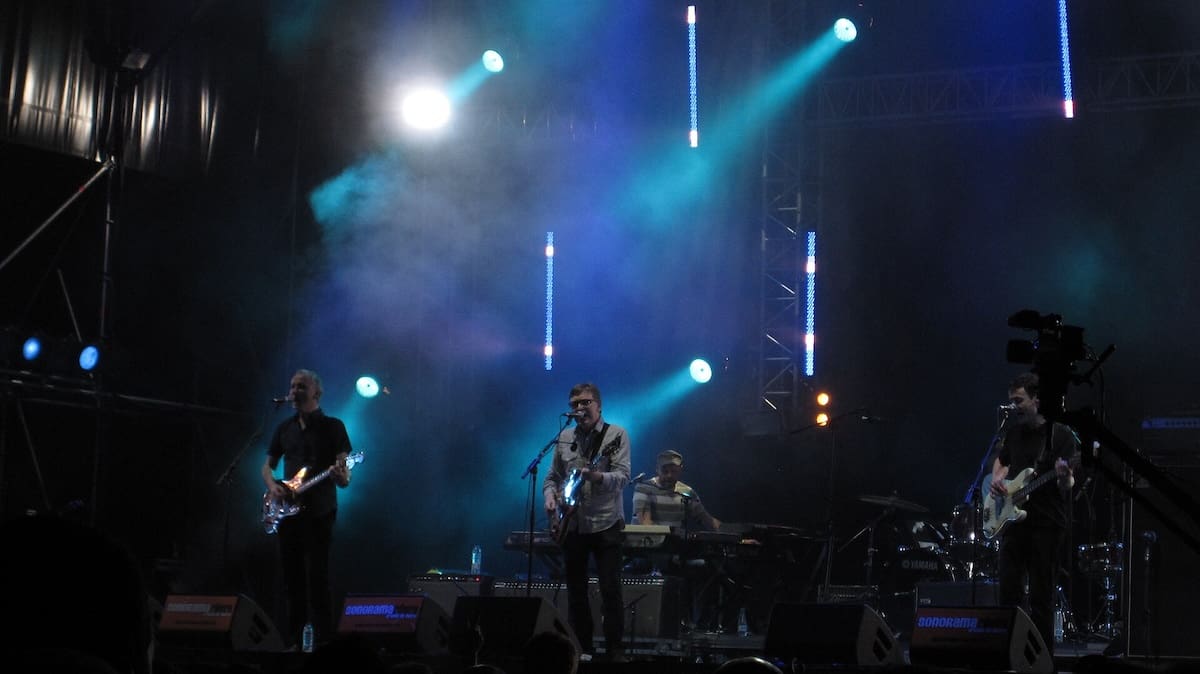
Thirty-seven years into a career built on quiet persistence rather than noise, Teenage Fanclub remain one of British guitar music's most reliable comforts. The Glasgow-via-Bellshill trio of Norman Blake, Raymond McGinley and Francis Macdonald return with Do Not Dare to Dream, their thirteenth studio album, and the first thing to say is: of course it's lovely. The second thing to say is that "lovely" has rarely felt so hard-won.
Thirteen albums deep
Teenage Fanclub are a Scottish alternative rock band formed in Bellshill in 1989, built around the songwriting of Norman Blake, Raymond McGinley and originally Gerard Love. They spent the early 90s being mistaken for shambling alt-rock jokers before 1991's Bandwagonesque and 1995's Grand Prix revealed a songwriting unit as melodically gifted as anyone of their generation.
They have weathered lineup changes with remarkable grace, most notably the departure of co-songwriter Gerard Love, absorbed since by Gorky's Zygotic Mynci's Euros Childs on 2021's Endless Arcade and 2023's Nothing Lasts Forever, a record on which Teenage Fanclub have not suffered from the departure of key founder member Gerard Love, incorporating Gorky's Zygotic Mynci singer Euros Childs into the line-up alongside the band's other songwriters Raymond McGinley and Norman Blake. It set the template - warm, unhurried, more interested in endurance than reinvention - that this new album extends.
Recorded at the edge of the map
The making of the record is almost as evocative as the music itself. The band's new album was recorded at Black Bay Studio on the remote Scottish island of Great Bernera, a setting guitarist Raymond McGinley invoked when describing the sense of continuity the sessions carried, noting:
It's been a while since we started doing this thing we do, but to us it feels like no time at all. In the place where we made the record people would have been singing thousands of years ago.
Raymond McGinley
That tension between the ancient and the ephemeral runs through the whole record, and gives even its gentlest melodies a faint, salt-worn gravity.
Blake, never one for grand pronouncements, admitted the difficulty of even titling the thing at this stage of a career, adding that it's especially tricky after you've made twelve of them. The album's title comes from "I Do Not Dare to Dream," one of ten tracks that also include "There Was You," "Tomorrow People," "Over and Over" and lead single "Day in the Sun".
The sound of acceptance
Critics who have heard the record mostly agree on the mood it creates. Mojo's review put it briefly and well: on their 13th album, the band wraps sad reflections on life in a soft, melodic glow. For a band whose last two records openly dealt with loss, ageing, and the simple business of carrying on, that's hardly a surprising turn.
Elsewhere, the album has been described as one that finds hope in everyday life without ignoring global uncertainty, using the studio's church organ and vintage synths alongside collaborators Euros Childs, Francis Macdonald and David McGowan, a widened sonic palette that gives these songs more room to breathe than some of their leaner 90s counterparts.
Nobody comes to a new Teenage Fanclub album expecting them to tear up the rulebook, and Do Not Dare to Dream doesn't try to. But as a document of a band easing gracefully into its fourth decade, still finding new shades of tenderness in familiar chords, it's a quietly moving addition to one of British indie's most dependable catalogues.
Featured photo by Rodelar / CC BY-SA — https://creativecommons.org/licenses/by-sa/4.0/